One in three mothers experience incontinence.
Many women experience it again during menopause.
Most of us stay silent.
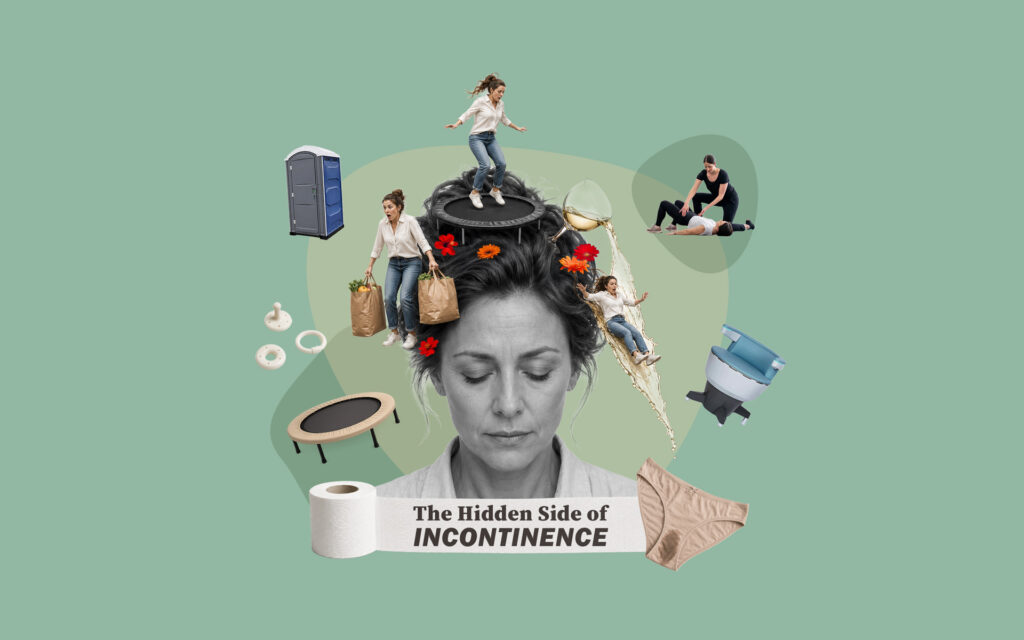
There are tiny calculations many women make every day. Before sneezing. Before laughing. Before running after their child. Before jumping on a trampoline. Before saying yes to another glass of wine. Calculations nobody talks about. Because for many women, leaking becomes part of life long before anyone explains why.
For some, it starts after childbirth. For others, it returns years later during menopause. For many women, it appears twice. And although urinary incontinence, the involuntary loss of urine, is one of the most common conditions women experience, it somehow remains one of the least discussed.
We whisper about it. We joke about it. We hide it. But we rarely call it by its name. And that silence matters.
Research shows that around 1 in 3 women experience urinary incontinence after childbirth, and for many, symptoms continue long after the first weeks.1 Furthermore, a 2025 study on menopause and urinary incontinence found that 30.8% of menopausal women experienced bladder leaks, with stress incontinence reported as the most common type in 59.5% of cases.2 Women with urinary incontinence also often wait an average of 6.5 years before seeking help.3 Sometimes because of shame. Sometimes because they assume it is “just part of motherhood.” Or “just part of getting older.”
But common is not the same as normal. And common certainly does not mean untreatable. The problem is not that millions of women experience it. The problem is that millions of women were never told what can actually help.
Most women hear one thing:
“Do your Kegels.”
And while pelvic floor exercises can absolutely help, treatment goes far beyond that.
We are not doctors. Every body, every birth, every cause of incontinence is different. There is no one-size-fits-all solution. This is not medical advice. Think of this as a starting vocabulary to discuss with qualified healthcare professionals.
Some women benefit from pelvic floor physiotherapy, often called Pelvic Floor Muscle Training (PFMT), a first-line treatment with strong clinical evidence behind it. But proper PFMT is not random Kegels from the internet. It is usually guided by a specialist trained to assess how the pelvic floor actually functions.
Others find support through hypopressive breathing, also known as Low-Pressure Fitness (LPF), a breathing and posture-based method growing in popularity across Europe. Unlike traditional pelvic floor exercises, hypopressives focus less on contraction and more on lift, pressure management, and deep core recovery.
For urgency, frequent toilet trips, or overactive bladder symptoms, bladder training can help retrain bladder habits and urgency signals over time.
For women in menopause, treatments like local vaginal estrogen can support tissues affected by hormonal changes, dryness, recurrent UTIs, irritation, and leakage symptoms. Unlike systemic HRT, it is a low-dose local treatment.
Others may benefit from support devices like a vaginal pessary, a removable silicone support device used for prolapse and stress incontinence, or minimally invasive procedures such as Bulkamid, a urethral bulking injection often used when physiotherapy alone is not enough.
There is also magnetic field therapy, also known as HIFEM or through devices such as Emsella and PelviPower. Women sit fully clothed while electromagnetic energy stimulates deep pelvic floor contractions. Personally, Emsella became one of the treatments that genuinely changed my quality of life after birth trauma and surgery.
Different bodies. Different solutions.
My Story, Briefly
After the birth of my daughter, things did not simply “go back to normal.”
My labour was long and traumatic. I ended up with a third-degree tear, a grade II cystocele, a grade III rectocele, and damage to my external sphincter. My diagnosis took months. The leaking started immediately, and suddenly I felt like I could not properly hold anything anymore. For a long time, my life became a series of small calculations. I always knew where the nearest bathroom was. I planned outings around toilet access. I carried spare underwear. Sneezing stopped being neutral. Lifting my daughter stopped being neutral.
There was embarrassment and frustration, but also something deeper. I slowly started withdrawing from people. For a long time, I avoided meeting friends or social situations because I was genuinely terrified that I would suddenly pee myself, or worse, in front of other people. The constant stress and lack of control pushed me into a very dark and depressive place that I rarely talked about openly at the time.
After reconstructive surgery and many treatments, things improved enormously. Today I still do Reformer Pilates with an instructor who understands my history, and I continue doing Emsella sessions once or twice a month to help strengthen my pelvic floor and core. It became one of the treatments that genuinely improved my quality of life after birth trauma and surgery. And still, despite all of that, it sometimes happens that I leak. Usually when I am extremely tired, or sometimes after one glass of wine too many.
What also makes me angry is that so many companies and brands market pads or special underwear for incontinence, focusing only on managing what is already happening, while far fewer conversations are centered around treatments, recovery, pelvic floor rehabilitation, or the fact that many women can actually improve their symptoms with proper support and care.
The Trampoline Is Still Off-Limits
One mom from the No Taboo Mom community kindly agreed to share her experience with incontinence and pelvic floor problems after childbirth. Her story was originally written in German and translated into English for this article. This is her story:
I’m 37 and have three children from two pregnancies — one spontaneous vaginal birth and one planned C-section with twins.
After my first pregnancy I already noticed my pelvic floor was weakened, but I managed to get on top of it over time. Then came the twins, and it felt like the problems doubled. Almost three years later, I’m still working on it.
The biggest limitations show up during physical activity. Jumping jacks and skipping rope are tricky, and trampolining is honestly my ultimate nemesis right now. Sneezing with a full bladder can also become an issue — especially if I’m not actively tensing my pelvic floor in that moment.
What’s changed most is how I feel in my own body. In certain situations I’m genuinely afraid of having an accident, which isn’t a nice feeling and does hold me back sometimes. My sex life, thankfully, hasn’t been affected.
Day to day, I manage mostly by staying aware of which situations are risky and avoiding them where I can. I don’t use pads or liners — they don’t suit me — so it’s more about being conscious and proactive. The tense-before-you-sneeze trick has become second nature.
What I haven’t done yet — and I honestly can’t explain why — is bring this up with my gynecologist. It’s at the top of my list for my next check-up.
Why Are We Still Whispering?
Maybe because women have always been taught to quietly manage discomfort. Maybe because leaking after birth has somehow become a punchline. Maybe because menopause conversations are still decades behind where they should be. Or maybe because women become experts at adapting.
We carry extra underwear. We avoid jumping. We stop drinking water before long car rides. We make small adjustments until they become normal. But silence has never healed anyone. Naming things does.
At No Taboo Mom we talk about subjects many women still feel expected to hide or minimize.
If this story resonated with you, or if there is a subject around womanhood, motherhood, or women’s health that you feel is still not being discussed openly enough, feel free to reach out to us by email or connect with us on Instagram.
Related articles and stories:
Your Sex Life After Birth. Or None at All?
Broken Vaginas – Understanding and healing Maternal Birth Injuries
Invisible Woman – Social demotion of aging women
References :
- International Urogynecology Journal – Prevalence, incidence and bothersomeness of urinary incontinence between 6 weeks and 1 year postpartum: a systematic review and meta-analysis
- Menopause, urinary incontinence prevalence and impact on healthy living
- Wolf, Naomi. Misconceptions. Truths, lies and the unexpected on the journey to motherhood.
Further reading :
Menopause and Pelvic Floor Disorders
Urinary Incontinence Impacts 25 Million Americans, but Many Are Too Ashamed to Discuss It
Coping with Postpartum Incontinence: Elle’s Story
Did you like this article?

Meet the Author
Ewa Gillen, co-founder of No Taboo Mom, is a Polish Berliner, creative professional, wife, and mom whose journey into motherhood turned everything around. She holds a Master’s degree in Creative Industries, and having studied, lived, and worked in Poland, Germany, Canada, Australia, and Spain, Ewa brings a rich cultural perspective to her work. As the founder of Gillen Design, she has worked as an Independent Creative Professional for nearly a decade, blending her expertise in design with her passion for meaningful storytelling. “No Taboo Mom is more than a platform—it’s a movement to inspire change through real, open conversations. I believe that by sharing our truths, we create a stronger, more compassionate world for ourselves and the next generation.”