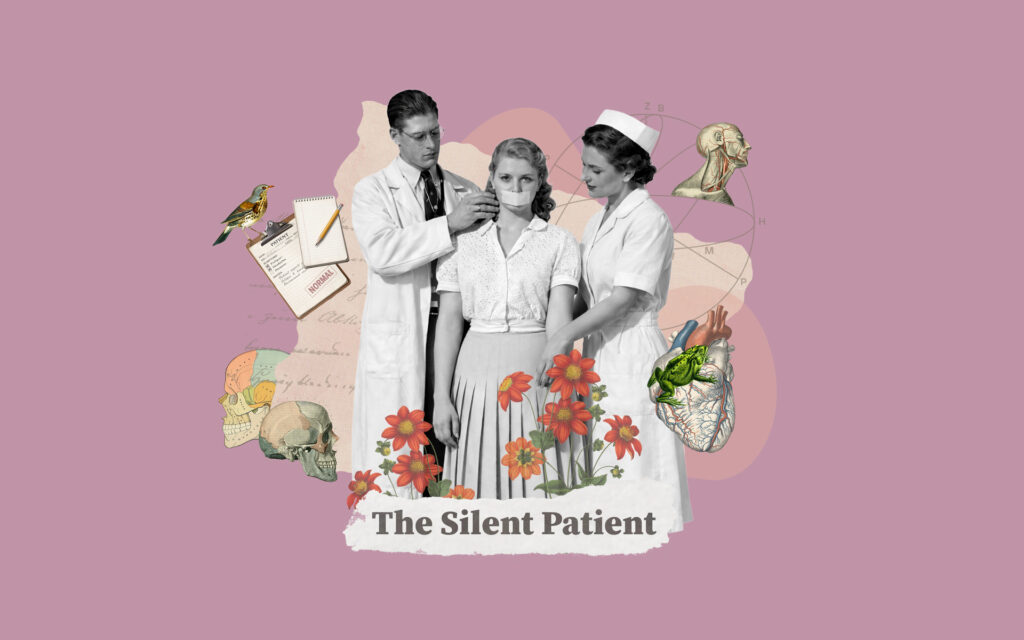
Why do so many women struggle to speak up to doctors? And how to change that.
I learnt very early on how easy it is to start doubting yourself in medical settings.
I have been in and out of hospitals for most of my life, so in many ways this isn’t a new story for me. It started when I was young —, a ruptured eardrum at 4, ovarian cysts at 11, bells palsy and then a very rare condition called hypogammaglobulinaemia, which meant my mother had to fight far harder than she ever should have had to just to get someone to keep investigating what was actually going on.
At one point, because my symptoms were so persistent and unusual, she was effectively put under suspicion for Munchausen by proxy. Instead of people simply admitting they didn’t yet have the answer, the possibility that she was exaggerating or somehow creating the problem was put on the table. But she kept pushing. She kept insisting they keep looking. And eventually, someone finally ran the right tests. And bam — there it was. A real diagnosis. Proof that something was wrong all along.
After that came more. A fall that caused a spinal injury and left me in traction in hospital for six months. Then rehab. Then a necrotised gall bladder caused by medication. Then extreme hypothyroidism. And now, more recently, family heart issues. Healthcare has never been some occasional inconvenience in my life. It has been a constant thread running through it.
And yet, despite all of that — despite the hospital stays, the tests, the diagnoses, the procedures, the endless contact with specialists and systems and waiting rooms — the thing I still struggle with most is speaking back to doctors when I know something isn’t right.
That’s the part that gets me.
A doctor can say, “It’s probably this,” and even when something in me knows it doesn’t add up, I still feel this reflex to say, “Okay.” I don’t challenge it. I don’t push back. I don’t always ask the extra question I know I should ask. I go quiet. I smooth it over. I act agreeable. Even when I’m not actually okay with what I’m hearing.
The pain scale is probably the best example of this. If someone asks me to rate my pain from one to ten, I will almost always undercall it. I’ll say five when, in reality, someone else — probably a man, if we’re being honest — would say twelve. Not because I’m confused about what pain feels like, and definitely not because I’m weak, but because somewhere along the line I learnt that my pain needed to be moderated before it could be made acceptable.
And I can trace a lot of that back to one moment.
When I was 11 and dealing with ovarian cysts, I was told at the hospital that I had a low pain threshold, that my periods weren’t that bad, and that message lodged itself somewhere deep. It became one of those offhand comments that adults make and forget, but children absorb and carry. It stayed with me. In some ways, it shaped the way I understood my body for years. Even now, my mum still says it to me sometimes — that I have a low pain threshold — and what’s wild is that I actually think the opposite may be true.
I don’t think I’m especially bad with pain. I think I have spent a lifetime learning how to function through more of it than I should have had to. I think I got very good at minimising, enduring, and explaining things away. I think I learnt, very young, that if I wanted to be taken seriously, I had to be careful not to seem dramatic — and in doing that, I probably ended up understating what was really going on.
That’s the part I keep coming back to now.
How many women have done the same thing? How many of us have been subtly trained to soften the truth of our own experience before we even open our mouths? How many of us have said, “It’s probably nothing,” when our body was telling us very clearly that it was not nothing at all?
Because when you are told early enough, and often enough, that your pain is too much, your reaction is too much, your concern is too much, you start editing yourself automatically. You start translating your body into more acceptable language. You start making your suffering easier for other people to hear.
And that can follow you for decades.
I think that is one of the reasons this conversation matters so much to me. Not just because I’ve spent so much of my life around hospitals and specialists and diagnoses, but because even with all that experience, I still know what it feels like to doubt myself in the room. To know something is wrong and still hesitate. To hear an answer and accept it outwardly while inwardly thinking, no, that doesn’t feel right.
So no, this isn’t about women being dramatic. If anything, I think many of us have become experts in doing the opposite. We minimise. We downplay. We wait. We tolerate. We second-guess. We try to be reasonable. We try to be easy. We try not to make a fuss. And sometimes that instinct costs us more than it should.
This pattern isn’t unusual
What I’ve started to realise over time is that this pattern isn’t unusual.
Once you start talking to other women about their experiences with doctors, you hear versions of the same story again and again. Not necessarily the same diagnoses or hospital stays, but the same strange hesitation in the room. The same instinct to soften what they’re saying before they say it. The same moment of walking out of an appointment thinking, I should have pushed back more.
Research from a number of countries has started to document something many women have known intuitively for a long time: women’s symptoms are more likely to be dismissed, minimised, or attributed to emotional causes before physical ones are fully investigated. Pain, in particular, is often underestimated when reported by women. In some studies, clinicians are more likely to assume women’s symptoms are linked to anxiety or stress, while men presenting with the same complaints are more quickly referred for diagnostic tests.
You can see how easily that kind of pattern starts to shape behaviour.
If your pain is questioned often enough, you start questioning it yourself.
If your concerns are brushed aside often enough, you start editing them before you even voice them.
And once that habit forms, it can be incredibly hard to break.
The system women are walking into wasn’t built with us in mind
Part of the reason this pattern is so persistent is that it isn’t just about individual doctors. It’s also about the history of medicine itself.
For centuries, medicine was designed, researched, and led primarily by men. Women were often excluded from clinical trials, their symptoms were interpreted through outdated assumptions about hysteria or emotional instability, and many conditions that primarily affect women were poorly understood or under-researched.
Even today, that legacy still shapes how symptoms are interpreted.
Research across Europe, the UK, the United States and Australia has shown that women’s pain is more likely to be underestimated by clinicians compared with men’s. Studies examining doctor–patient communication also show that women are more frequently interrupted during medical consultations and are more likely to have symptoms attributed to anxiety or stress before physical causes are explored.
None of this necessarily comes from bad intentions. Most clinicians genuinely want to help their patients. But healthcare systems are built on habits, training, and cultural assumptions that evolve slowly. And those assumptions can influence how symptoms are interpreted long before anyone realises it.
There is also a clear power dynamic built into medical environments.
Doctors hold specialised knowledge. They control time in the appointment. They decide what gets investigated and what doesn’t. Patients enter that room already at a disadvantage, and when you add gender expectations on top of that — expectations that women should be agreeable, calm, and not overly demanding — it becomes easy to see how many women end up softening their own experiences.
So when women hesitate to push back in medical settings, it isn’t simply a confidence problem.
It is the result of a long cultural history that has trained women to doubt themselves while simultaneously placing authority firmly on the other side of the desk.
Understanding that context matters, because it shifts the conversation away from “women need to be more assertive” and toward a more honest truth:
Many women are navigating a system that hasn’t always been very good at listening to them.
Learning to undo the habit of minimising
Which raises a difficult but important question: if so many of us have been conditioned to minimise our symptoms, how do we start undoing that habit?
Because advocating for yourself in a medical setting is not as simple as just deciding to be more confident. It involves unlearning years — sometimes decades — of subtle messaging about what is considered acceptable behaviour, especially for women.
For me, the first step has been recognising when that instinct to minimise kicks in.
When a doctor asks about pain now, I try to pause before answering. I try to describe what I’m actually experiencing rather than what sounds reasonable. Instead of saying “it’s not too bad,” I try to explain what the pain is stopping me from doing. Whether it’s interfering with sleep, making it hard to work, or affecting daily life.
Pain that “isn’t too bad” is easy to dismiss. Pain that prevents someone from sleeping, working, or functioning normally becomes harder to ignore.
The same is true for questions.
What else could this be? Are there other possible explanations? What tests would rule those out? What should I do if this treatment doesn’t work?
Those questions don’t undermine a doctor’s authority. They open space for a more thorough conversation.
Things women should never feel embarrassed saying to a doctor
There are so many things women are trained to soften before saying out loud.
But some sentences deserve to be spoken exactly as they are.
– This pain is affecting my daily life.
– I know my body, and something feels wrong.
– I would like this investigated properly.
– Can you explain why you think that?
– What else could it be?
– What happens if this treatment doesn’t work?
– I would like a second opinion.
– Can that be noted in my file?
None of those statements are dramatic. They are simply part of participating in your own healthcare.
For a long time women have been taught that good patients are the quiet ones — the ones who nod politely, say thank you, and leave.
But being easy to manage is not the same thing as being well cared for.
Sometimes the most important thing a woman can do in a medical appointment is stop translating her pain into something more comfortable for somebody else to hear.
Sometimes the sentence needs to come out exactly as it is.
This is not normal for me. This is getting worse. I need you to take this seriously.
Take note
It is okay to be a pain in the doctor’s ass. It is okay to ask the follow-up question, to challenge the rushed answer, to say, no, that does not explain it properly, I need you to look again. Because the only person who knows what it feels like to live in your body is you. And that matters.
You are not here to be the easiest patient in the room. You are here to get care.
So if that means being persistent, being awkward, being inconvenient, or refusing to leave with a half-arsed answer, so be it. Better to be a pain in somebody’s side than to spend another decade betraying your own instincts just to sound reasonable.
A simple doctor appointment prep list (for the moments your brain goes blank)
Medical appointments can be strange environments. Even when you walk in prepared, it’s easy to forget half of what you meant to say the moment someone in a white coat starts asking questions.
Writing things down beforehand can make a huge difference. Not because you need to prove anything, but because it helps make sure the important details don’t get lost.
Here’s a simple checklist that many patients find helpful.
Before your appointment
Write down the reason you’re going in. Try to be as specific as possible.
● What symptoms are you experiencing?
● When did they start?
● Are they getting worse, better, or staying the same?
● What seems to trigger them?
● What makes them better or worse?
It can also help to note:
● Medications or supplements you’re taking
● Recent illnesses or health changes
● Family history related to the issue
● Anything unusual you’ve noticed in your body
Sometimes the smallest detail can end up being clinically important
Describe the impact, not just the symptom
Doctors often understand problems more clearly when they know how the issue affects daily life.
For example:
Instead of: “I get headaches.”
Try explaining: “These headaches are waking me up at night and making it hard to work.”
Instead of: “My periods are painful.”
Try: “The pain is bad enough that I sometimes can’t stand upright or go to work.”
Impact gives doctors a clearer picture of severity.
Bring a short list of questions
It’s easy to forget questions during appointments, especially if the conversation moves quickly.
You might want to ask things like:
● What could be causing this?
● Are there other possible explanations?
● What tests might help clarify this?
● What treatment options are available?
● What should I do if this doesn’t improve?
Even two or three written questions can help keep the appointment focused.
Consider bringing someone with you
If the issue is complex, stressful, or emotional, it can help to bring a support person.
They can:
● Help remember information
● Ask questions you might forget
● Take notes
● Support you if the conversation becomes overwhelming
Many people find they recall far more of the discussion when someone else is present.
Take notes during the appointment
If the doctor explains a diagnosis, treatment plan, or next steps, it’s completely reasonable to write things down.
You can also ask:
“Would you mind if I wrote this down so I remember it properly?”
Most clinicians are happy to slow down for that.
Before leaving the appointment
Make sure you understand:
● The likely diagnosis (or possible diagnoses)
● The treatment plan
● What symptoms should improve
● When you should return or follow up
● What to do if symptoms worsen
If anything feels unclear, it’s okay to ask the doctor to repeat or explain it again.
One last thing
You are allowed to take up space in that room.
You are allowed to ask questions.
You are allowed to say when something doesn’t feel right.
And you are allowed to leave an appointment with clarity rather than confusion.
Healthcare works best when patients are part of the conversation — not just observers in it.
FAQs
Why do women often feel dismissed by doctors?
Research across multiple countries shows women’s symptoms are more likely to be attributed to emotional causes or minimised before physical causes are fully investigated. Gender bias, communication styles, and historical gaps in women’s health research all contribute.
Do women really underestimate their pain?
Studies suggest women frequently downplay symptoms in medical settings. Social conditioning around being agreeable and not “making a fuss” can lead women to soften descriptions of pain or distress.
Why is the pain scale sometimes inaccurate?
The 1–10 pain scale is subjective. Many patients underestimate their pain because they compare themselves to imagined extremes or worry about sounding dramatic.
How can I advocate for myself at a doctor’s appointment?
Preparation helps. Write down symptoms, timelines, and questions beforehand. Be specific about how symptoms affect daily life, and ask follow-up questions if something doesn’t make sense.
Is it okay to ask for a second opinion?
Yes. Seeking a second opinion is common and often recommended when symptoms persist or a diagnosis is unclear.
What should I do if I feel dismissed by a doctor?
You can ask for clarification, request further investigation, or seek another healthcare provider. Feeling heard and respected is an important part of good medical care.
Related articles:
Broken Vaginas – Understanding and healing Maternal Birth Injuries
Did you like this article?

Meet the Author
Tasch Turner has spent more than two decades working in women’s healthcare as a psychology-qualified copywriter and marketing consultant. She helps women make sense of complicated symptoms, conversations, and medical systems – without being talked down to. After being dismissed and told she was overreacting, she’s committed to making sure other women don’t second-guess themselves into silence. Her writing is direct, evidence-informed, and designed for women who want answers.