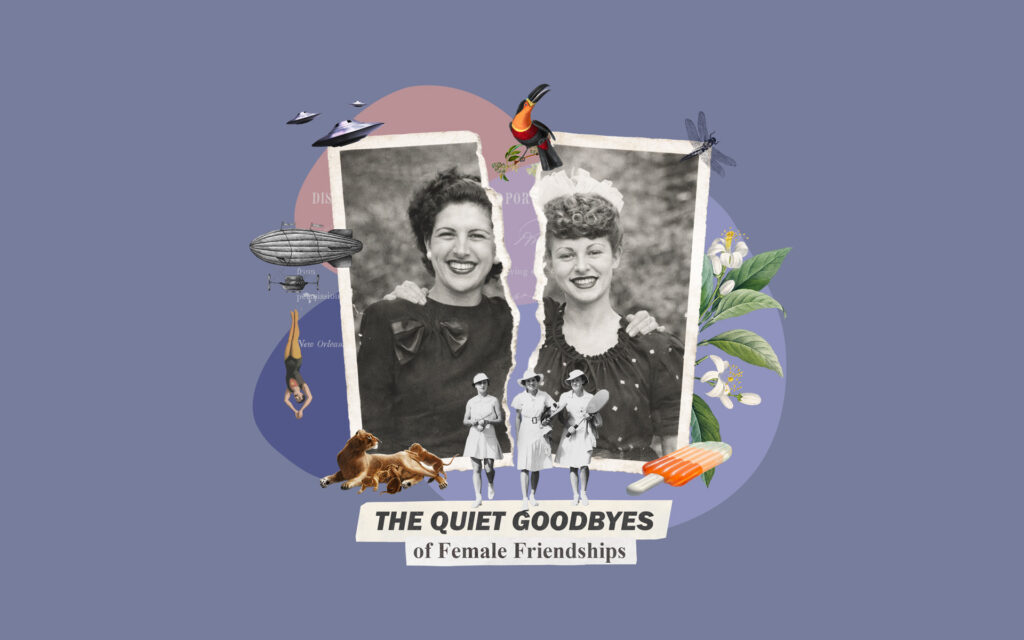
Sometimes I think about old friends, women, who once belonged so naturally to my life.
Women I talked to late into the night.
Women I shared things with that I rarely told anyone else.
Women with whom I felt: Here, I don’t have to explain myself.
We sent each other voice messages that lasted ten minutes. We talked about doubts, about relationships, about our bodies, about our fears, hopes and dreams. Sometimes we cried together. Sometimes we laughed so hard we could barely breathe.
And at some point, often without me being able to say exactly when, those friendships grew quieter.
The messages became fewer.
The meetings became rarer.
The connection thinner.
Not because of a fight. Not because of some great hurt. But more like a thread slowly beginning to fray. And one day you realize: the person who once felt so close is now only a memory. We are strangers now.
What keeps occupying my mind is not just the loss. It is the question: Why does this seem to happen so often in the way many women experience friendships? Because when I talk to other women about it, I hear surprisingly similar stories and experiences. Deep closeness. Great trust. And then, somehow, a drifting apart that is hard to explain.
Scientific Perspectives
1. Female friendships often grow from emotional closeness
Many studies suggest that friendships among women are often built more strongly on emotional exchange and self-disclosure (see research on friendship communication). While men often connect through shared activities (sports, projects, hobbies), friendships between women frequently grow through conversation and the sharing of personal experiences.
This can create a strong sense of intimacy—sometimes quite quickly.
That closeness can be incredibly empowering. Research suggests that close friendships between women can strengthen self-esteem and create a stronger sense of control over one’s life.
But this emotional depth may also make friendships more sensitive.
2. Women often respond to stress by connecting
An important concept in stress research is the “tend-and-befriend” response, first described by Shelley E. Taylor and colleagues. While stress responses have often been framed as “fight or flight,” research suggests that many women also respond by seeking connection, nurturing others, and strengthening social bonds.
Biologically, the hormone oxytocin plays a role here, as it is associated with trust and bonding between people.
This means that for many women, friendships are not just something pleasant in life.
They are often an essential emotional support system.
3. High expectations can make relationships fragile
Because friendships between women can be so emotionally deep, they often carry strong, sometimes unspoken expectations.
For example:
mutual support
emotional availability
understanding
loyalty
When that balance changes, even subtly, a friendship can become fragile.
Not necessarily because someone did something wrong.
But because something in the dynamic between two people shifted.
Research on close relationships suggests that the loss of a close friendship can be emotionally comparable to a romantic breakup (see studies on relational dissolution and emotional impact, e.g. Social Psychology).
And many friendships do not end with a dramatic conflict.
Instead, they slowly fade away.
4. Life stages change friendships more than we think
Another important factor is life transitions. Research shows that friendships often shift during major changes such as:
– moving to a new place
– entering or leaving relationships
– having children
– changes in work or career
Especially for women, a new partnership or family life can require large amounts of time and emotional energy. Friendships may unintentionally move into the background. Two people who were once very close may simply find themselves living in different worlds.
The Quiet Ending
Sometimes I wonder whether friendships between women might be a little like seasons. Some last a lifetime. Others walk beside us only for a certain part of the journey. And maybe that does not always mean failure. Maybe that friend was exactly the person we needed in that particular chapter of our lives. Maybe we gave each other something we needed at the time. And then life kept moving.
Still, sometimes I wish we were better at holding on to friendships. That we spoke more openly when something begins to change. That we dared to say, out loud:
“You matter to me. I don’t want to simply lose you.”
Because friendships between women can be something very special. A space where we are allowed to show ourselves with all our questions, doubts, fractures, and hopes. And perhaps that is the beginning of a new kind of friendship between women: One that does not have to be perfect. But honest.
An Open Question to You
This is something I have been thinking about for a long time. I have experienced beautiful, deep friendships with women. And I have also lost some of them without ever really understanding why.
So I would love to hear about your experience.
Do you have friendships with women that have lasted for many years, maybe even decades?
Did you go through conflicts and still stay connected?
Or have you also experienced that very close friendships slowly drift apart?
And if that happened, did you ever find an explanation for it?
I would truly love to hear your stories.
References & Further reading:
Research on friendship communication
Shelley E. Taylor et al., Tend-and-Befriend Theory
Women’s friendship dissolution: A qualitative study
Related articles:
Invisible Woman – Social demotion of aging women
Did you like this article?

Meet the Author
Julia Kolbe, co-founder of No Taboo Mom, is a Berliner, psychiatric nurse, medical instructor, wife, and mom of two girls. She holds a Master’s degree in Health, Nursing, and Medical Education with a focus on Nursing Pedagogy, equipping her to bridge professional care and education with real-life experience. Working in German healthcare, she saw firsthand the gaps in addressing women’s well-being, particularly during pregnancy and motherhood. These experiences inspired her to take action and advocate for a more holistic and compassionate approach to women’s health. “No Taboo Mom is about breaking the silence and fostering honest conversations. By sharing our stories, we empower women to navigate the unspoken challenges of womanhood and motherhood with strength and solidarity.